
2bis avenue des Gobelins
Branches and foliage emerge from the sides of the door, invade the lintel and climb up on either side of the window above the door. Architect JP Marquet. 1905
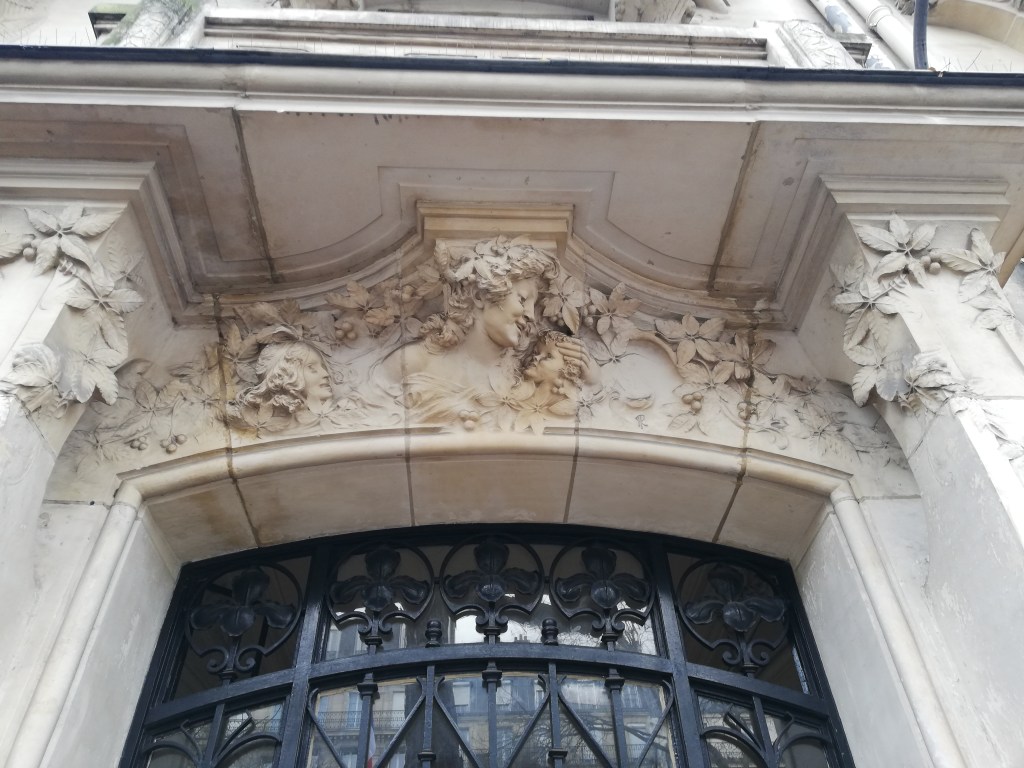
4 avenue des Gobelins
On the key above the door: a woman’s face in profile holding her child’s head, another female profile to the left. Foliage continues on the columns on either side of the door. Architect JP Marquet Sculptor P. Seguin. 1905

10 avenue des Gobelins
Beautiful ironwork on the door. Lintel adorned with two peacocks and oak branches, oak leaves on the key. The door frame is adorned with a garland of flowers and finished with two consoles adorned with roses.
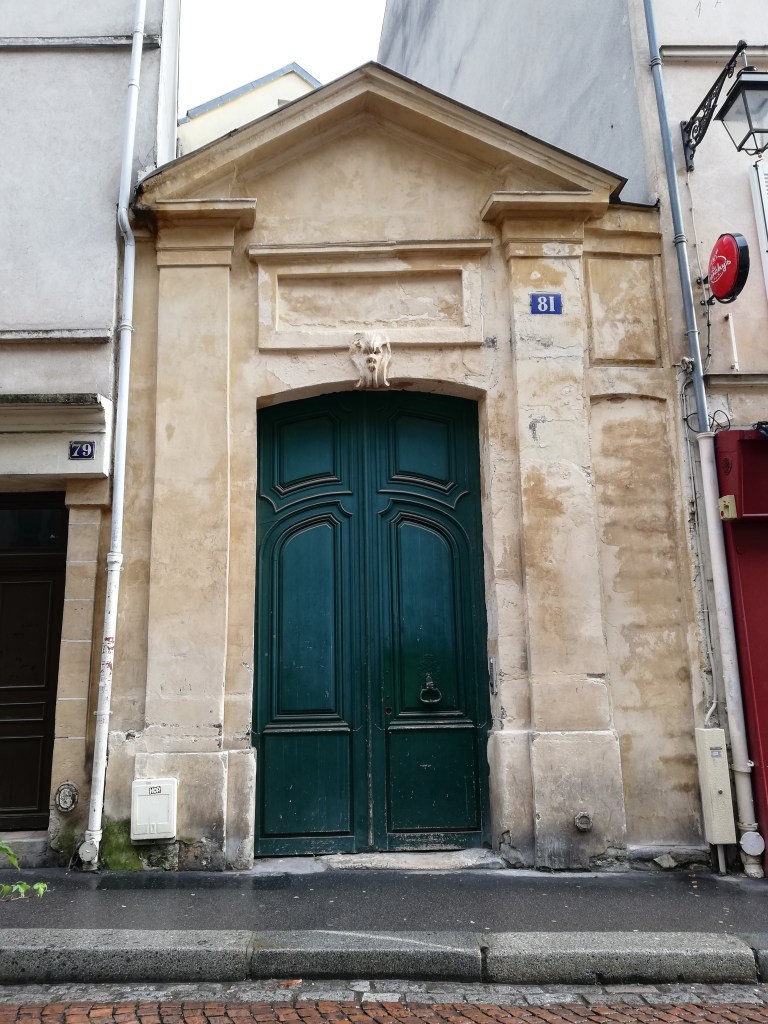
81 rue Mouffetard
Very simple, elegant stone gate: two pilaster columns topped by a triangular pediment. Shell motif above a beautiful 18th-century door.

25 rue Jussieu
Clasp decorated with a bas-relief entitled Au buisson ardent, in memory of a cabaret that existed on this site in the 18th century and was famous for its crayfish bushes. The bas-relief illustrates the episode of Moses’ encounter with God incarnate in a burning bush (Book of Exodus, chapter 3, verse 2).
Other doors of interest:
| 10 boulevard Port Royal | Arched doorway. The frame is adorned with a delicate garland of flowers. The transom above the door is decorated with a motif composed of half-ovals, typical of Art Deco. |
| 13 place du Panthéon | Two modillions frame the door, one on the left depicting a seated monk holding a parchment and the other on the right a woman with long hair, pregnant and holding an unidentified object. |
| 14 rue de l’Abbé de l’Epée | An imposing liana with flowers frames the wrought-iron door with its plant motif. Architect Le Roy |
| 14 rue Saint Julien le Pauvre | Porch of a private mansion adorned with a large carved semicircular pediment, depicting the allegory of justice with a cherub. |
| 16 rue des écoles | Roaring Lion |
| 1bis rue Lapécède | Olive branch above the door. Architect A. Champy |
| 20 rue de l’abbé de l’Epée | Door flanked by two columns topped by Doric capitals and a broken pediment. Head of Hercules covered with the skin of the Nemean lion above the door. |
| 21 boulevard Saint Germain | Caryatids on either side of the door leaves. |
| 24 rue Linné | Neo renaissance. The door lintel is a veritable gallery of portraits, with four profiles in medallions framing a woman’s bust on the keystone above the door. This alignment of portraits is punctuated by corbels and the keystone, creating an alternation of projecting and recessed figures. Two faun masks to the left and right of the door further enhance the animation of this highly detailed decoration, with its fluted half-columns and frieze of dentils and beads. |
| 25 rue Linné | Triangular pediment decorated with the blazon of the City of Paris |
| 25 rue Monge | Two sheathed caryatids frame the transom window. Their arms are crossed, which is unusual. Neo-Renaissance decor on the lintel. Grotesque male mascaron. |
| 26 rue Gay Lussac | Two demons flank the door, each holding a shield. One of them bears the architect’s initial Seitz. 1868 |
| 29 rue de La Parcheminerie | Rounded twin doors. Keys decorated with beautiful rocaille motifs. Architect Martin Goupy. 1736 |
| 35 rue Monge | Two dragons frame the building number. Bird’s nest under a window. |
| 59-61 rue de Galande | A female mascaron with flowing, abundant hair that follows the rounded shape of the doorway. Architect Bressy |
| 7 rue des Chantiers | The insignia of the Compagnons du Devoir is pinned above the door. |
 Une journée à Paris